
Food Truck Hand Sink Requirements: What Health Inspectors Actually Check
Sep 21st 2026
Food truck hand sink requirements are not identical everywhere, but the same core issues come up repeatedly during plan review and inspection: whether the truck has a dedicated handwashing sink, whether the sink provides water at the required temperature, whether the basin meets local size requirements, and whether the fresh- and wastewater systems have enough capacity for the operation.
The FDA Food Code provides a national model for retail food safety, while state and local authorities decide which provisions they adopt and whether they add different or stricter requirements. That means a sink that works for one food truck may not automatically satisfy another jurisdiction. FDA describes the Food Code as a model used by regulatory jurisdictions to develop or update their own food-safety rules. FDA Food Code
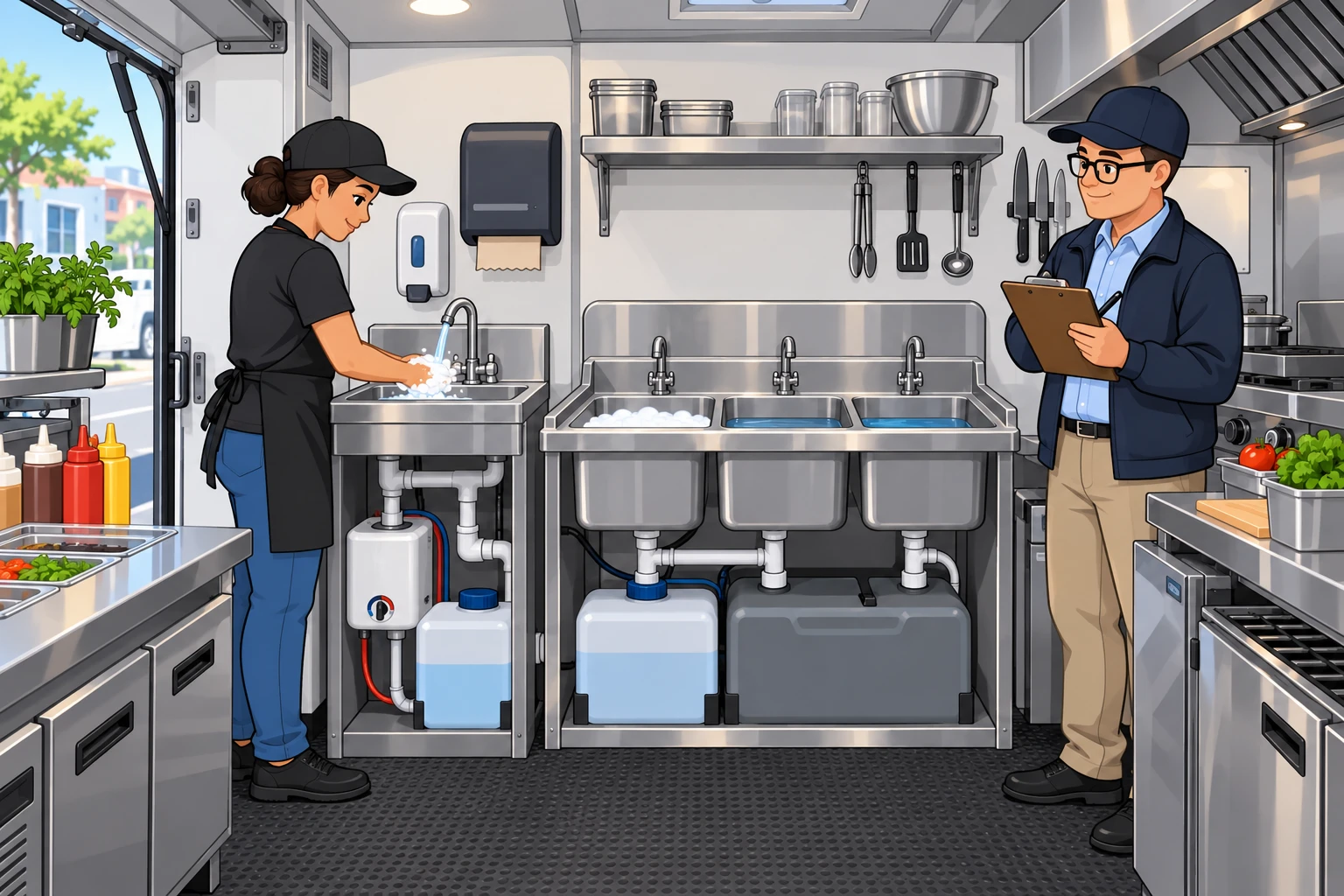
Before ordering equipment, confirm the requirements that apply where your truck will be licensed and inspected.
If you are comparing equipment options, browse our portable hand wash stations to compare basin configurations, water-temperature options, and cabinet styles.
Does a Food Truck Need a Dedicated Handwashing Sink?
A handwashing sink and a warewashing sink serve different purposes.
Under the FDA Food Code, a handwashing sink must remain accessible for employee use and may not be used for purposes other than handwashing. A three-compartment sink, by contrast, is used for washing, rinsing, and sanitizing utensils and equipment. 2026 FDA Food Code
For many mobile food operations, that means both functions are needed:
- a dedicated basin for employee handwashing; and
- separate warewashing basins for utensils and equipment.
This distinction matters when planning a compact food truck interior. Having a three-compartment sink does not automatically eliminate the need for a separate handwashing basin.
A combined unit can place warewashing and handwashing functions in one cabinet as long as the handwashing basin remains separate and dedicated to handwashing.
For operators who need both functions in one cabinet, our Food Truck Hand Wash Sink – 4 Compartment with Hot Water, Model 35-0090 combines three warewashing basins with a separate handwashing basin.
What Water Temperature Does a Food Truck Hand Sink Need?
The FDA Food Code requires a handwashing sink to be equipped to provide water at a temperature of at least 85°F (29.4°C) through a mixing valve or combination faucet. FDA changed the model-code minimum from 100°F to 85°F beginning with the 2022 edition, and that requirement remains part of the current Food Code. FDA Summary of Changes in the 2022 Food Code
Because the FDA Food Code is a model for adoption, state and local requirements may differ. Confirm the temperature standard enforced where your food truck will be licensed or inspected.
This is one of the first specifications to verify before choosing between a cold-water and heated handwashing station. If tempered or heated water is required, the station needs a heater and electrical service capable of supporting that requirement during normal operation.
When comparing equipment, check the actual heater type and power requirements rather than relying only on a product name that says “hot water.”
You can also compare hot- and cold-water portable handwashing stations based on heater type, basin configuration, and electrical requirements.
What Size Hand Sink Does a Food Truck Need?
The FDA Food Code provisions for handwashing sinks do not provide one universal numeric basin size for every food truck. State and local authorities may apply additional dimensional requirements, so verify the required basin width, length, and depth before selecting equipment.
Because food trucks have limited floor space, operators may be tempted to choose the smallest sink available. That can create a problem if the basin does not meet the local standard.
Before purchasing a hand sink, obtain the basin requirements from the authority that will license or inspect the truck. Then compare those requirements with the interior basin dimensions, not just the overall dimensions of the cabinet.
Do not assume that terms such as “commercial,” “portable,” or “food truck sink” mean the basin automatically satisfies the requirements in your jurisdiction.
How Much Fresh Water Does a Food Truck Hand Sink Need?
The FDA Food Code does not specify one universal gallon capacity for every mobile food establishment. Instead, the water source and system must have sufficient capacity to meet the food establishment’s peak water demand. 2026 FDA Food Code
The amount of water needed depends on the operation. Factors can include the number of employees, how frequently hands are washed, how long the truck operates between refills, and whether the same freshwater supply also serves warewashing or other approved functions.
A handwashing-only station may consume water differently from a four-compartment system that supplies three warewashing basins plus a separate handwashing basin.
For that reason, tank capacity should be evaluated against the actual operation rather than treated as a one-size-fits-all number.
When reviewing a station, determine whether its freshwater capacity satisfies any minimum required by the local authority and whether it is large enough for the expected service period without impractical refill interruptions.
How Much Wastewater Capacity Is Required?
Wastewater capacity is just as important as freshwater capacity.
Under the FDA Food Code, a sewage holding tank in a mobile food establishment must be sized 15% larger than the water-supply tank. This allows additional capacity for used water generated from the onboard water supply. 2026 FDA Food Code
For example, a system with a 5-gallon freshwater tank would need at least 5.75 gallons of wastewater capacity to meet that 15% requirement.
When comparing portable sinks, review both tank capacities. A freshwater number by itself does not tell you whether the system is appropriately configured for mobile food service.
Local authorities may also regulate how wastewater is stored, drained, transported, or disposed of, so wastewater capacity should be reviewed as part of the complete mobile-food setup.
What Do Health Inspectors Actually Check at a Food Truck Hand Sink?
Inspection procedures vary by jurisdiction, but the FDA Food Code baseline identifies several equipment and operating conditions that may be relevant during plan review or inspection.
An inspector may evaluate whether:
- a dedicated handwashing sink is provided where required;
- the sink is accessible to employees;
- the basin is reserved for handwashing rather than warewashing or food preparation;
- the water reaches the required temperature;
- the basin meets applicable dimensional requirements;
- the freshwater supply is adequate;
- the wastewater tank has sufficient capacity;
- soap is available; and
- an approved hand-drying method is provided.
The FDA Food Code requires hand-cleaning soap at handwashing sinks and an approved hand-drying provision, such as disposable towels or qualifying hand-drying equipment.
The exact inspection criteria can extend beyond these points depending on the jurisdiction.
The goal is not to treat this as one universal inspection checklist. It is to identify the specifications that should be confirmed before the food truck is built or the sink is purchased.
Why Food Truck Hand Sink Requirements Vary by County or State
The FDA Food Code is a model code. State and local regulatory agencies use it to develop or update their own food-safety rules, so the requirements actually enforced can vary by jurisdiction.
That creates several areas where food truck requirements can differ.
Water Temperature
The FDA model establishes an 85°F minimum at a handwashing sink, but a jurisdiction may enforce a different or higher minimum under its adopted code.
Basin Dimensions
The FDA Food Code does not establish one universal food-truck hand-sink dimension. Local authorities may specify minimum basin measurements.
Freshwater Capacity
A jurisdiction may require a particular minimum water supply or evaluate whether the available capacity is sufficient for the proposed operation.
Wastewater Capacity
The FDA model requires the mobile wastewater holding tank to provide 15% more capacity than the water-supply tank. Local authorities may impose additional requirements related to tank construction, handling, or disposal.
Dedicated Handwashing
The FDA model requires a handwashing sink to remain dedicated to handwashing. Local plan-review requirements determine how that function must be incorporated into a particular food truck layout.
Because requirements vary by jurisdiction, avoid relying on broad claims such as “health-code compliant everywhere.” Confirm the rules that apply where your food truck will be licensed or inspected.
How to Choose a Food Truck Hand Sink
Start with the requirements that can determine whether a sink is suitable before comparing appearance or convenience.
1. Confirm the Water-Temperature Requirement
Find out what minimum handwashing-water temperature applies to your operation. This determines whether a cold-water station can be considered or whether heated water is required.
2. Confirm the Basin Dimensions
Ask whether the jurisdiction specifies a minimum width, length, or depth. Compare those requirements directly with the sink's interior basin dimensions.
3. Determine Whether a Separate Hand Sink Is Required
If the truck already has a three-compartment warewashing sink, do not assume one of those compartments can also serve as the employee handwashing sink.
Confirm whether a dedicated handwashing basin is required.
4. Check Fresh- and Wastewater Capacity
Make sure the station can support the expected handwashing demand and any minimum tank requirements. Where the FDA model applies, the wastewater holding tank must provide 15% more capacity than the water-supply tank.
5. Verify the Equipment Requirements
If the station uses an electric pump or water heater, make sure the truck or operating site can provide the required electrical service.
Once these requirements are known, comparing models becomes much easier because you can evaluate the specifications that actually matter to your operation.
Standalone Hand Sink or 4-Compartment System?
The right configuration depends on what the food truck already has.
A standalone handwashing station makes sense when the truck already has the required warewashing setup and only needs a dedicated hand sink.
A four-compartment system can be useful when the operator needs both functions in one cabinet:
- three basins for washing, rinsing, and sanitizing utensils; and
- one separate basin for employee handwashing.
The important distinction is that combining the equipment into one cabinet does not combine the functions. The handwashing basin remains dedicated to handwashing.
For a new food-truck build, this decision should be made before the interior layout is finalized. For an existing truck, compare the available space with the equipment dimensions after confirming the applicable local requirements.
Food Truck Hand Sink Requirements: Pre-Purchase Checklist
Before purchasing a food truck hand sink, confirm:
- the required handwashing-water temperature;
- required basin dimensions;
- whether a dedicated handwashing basin is required;
- freshwater-capacity requirements;
- wastewater-capacity requirements;
- soap and hand-drying requirements; and
- electrical requirements for the pump or water heater.
The FDA Food Code provides the national baseline, but the authority that licenses or inspects the food truck determines which requirements apply to the operation.
Once those requirements are clear, you can compare handwashing stations based on the specifications that matter rather than trying to correct an equipment mismatch after the sink has already been installed.
*This checklist covers common requirements but is not exhaustive. Additional requirements may apply based on your state, county, or local health department.