
Portable Handwashing Stations for Schools, Daycares, and Preschools
Oct 30th 2026
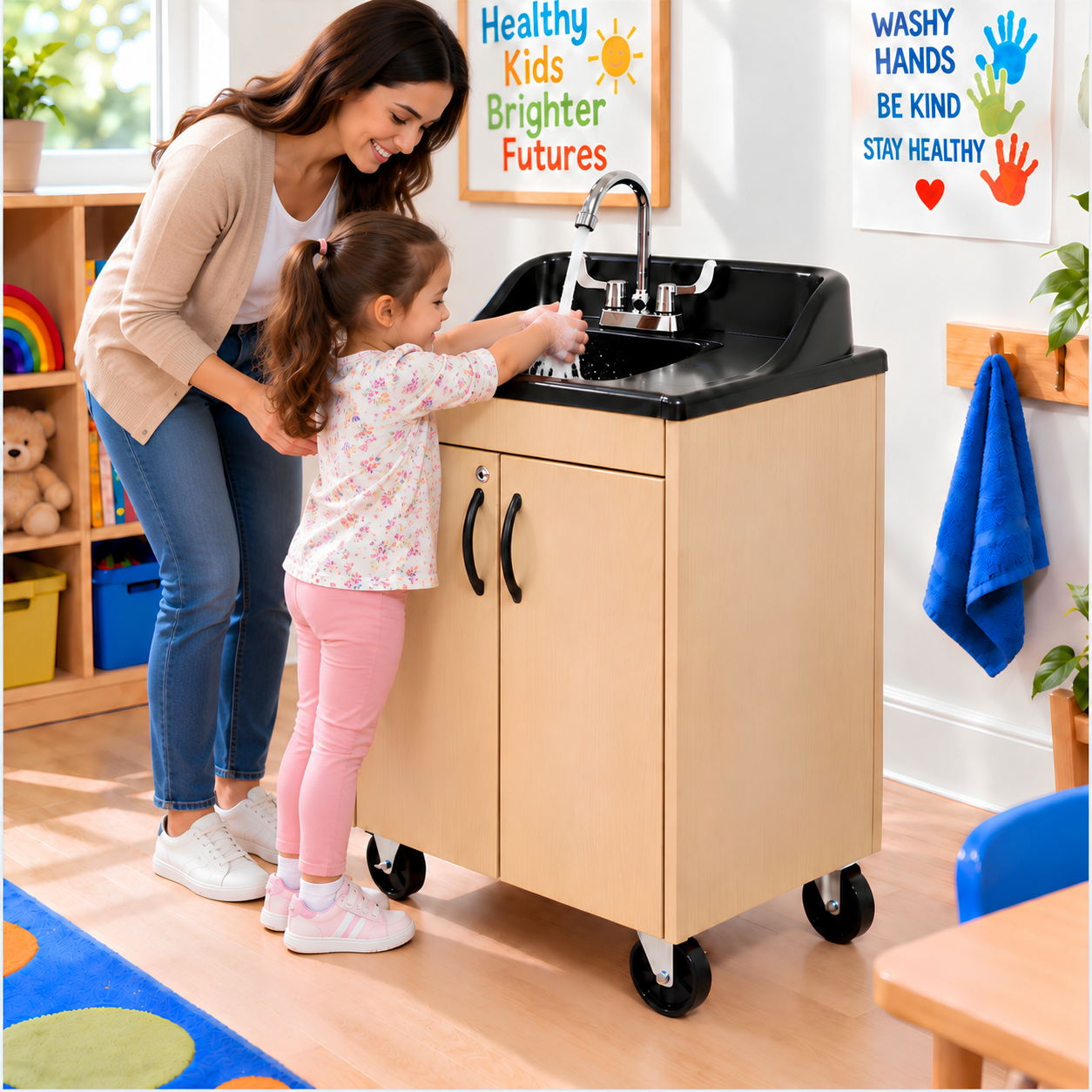
Portable handwashing stations provide additional access to running water in schools, daycares, and preschools, particularly in classrooms where permanent sinks are unavailable or inconvenient.
Self-contained models use onboard freshwater and wastewater tanks, eliminating the need for fixed plumbing connections.
School administrators and childcare operators should consider children's accessibility, adult supervision, station placement, water supply, and electrical requirements when selecting equipment.
Where Can Portable Handwashing Stations Be Used in Educational Facilities?
The need for additional handwashing access can vary depending on how each educational space is used. Common applications include:
- School classrooms: Provide nearby handwashing access during art projects and other hands-on activities in rooms without permanent sinks.
- Preschool classrooms: Support handwashing following crafts, sensory activities, and before snack time.
- Daycare activity areas: Give caregivers a nearby station where they can assist younger children with handwashing after group play and other shared activities.
- Activity and multipurpose rooms: Provide shared handwashing access for after-school programs, extracurricular activities, or groups using spaces without permanent sinks.
- Temporary learning spaces: Add handwashing access during renovations, short-term programs, or changes in facility use.
Where Should Handwashing Stations Be Placed in Schools and Classrooms?
Handwashing stations should be positioned where students and staff can reach them without disrupting classroom activities or creating obstacles.
When choosing a location, consider:
- Proximity: Place the station near activities where handwashing is regularly needed.
- Clearance: Keep doorways, emergency exits, and walking paths unobstructed while allowing staff access to the cabinet for servicing.
- Stability: Place the station on a firm, level surface and lock its casters, where equipped, before use.
- Electrical access: Use a suitable power source without leaving exposed cords across student walkways.
How Can Schools Make Handwashing Accessible and Safe for Children?
Children's age, height, mobility, and ability to operate a faucet should influence equipment selection.
Our Premier handwashing stations have different front sink heights: approximately 37 inches for the standard Premier and 32 inches for the Premier Junior, measured from the floor to the front countertop edge rather than the rear splashguard. The lower-profile Junior is intended for preschool and daycare environments, but sink height alone does not establish accessibility compliance.
When evaluating equipment, consider:
- Sink height: Determine whether children can comfortably reach the basin and faucet.
- Accessibility: Check whether students using mobility aids can approach the station and reach the faucet. If the station is intended to serve an accessible handwashing function, evaluate the required clear floor space, knee and toe clearance, and faucet operability.
- Adult supervision: Younger children must be directly supervised by a teacher or caregiver whenever they use a portable handwashing station. Staff should assist with faucet operation as needed. See CDC guidance for additional handwashing recommendations.
- Water temperature: Staff should check the water temperature at the faucet before younger children use a heated station and adjust the temperature controls, where available, to meet facility requirements.
Avoid relying on unstable platforms or improvised arrangements to help children reach a sink.
What Water Supply and Electrical Service Do Portable Stations Need?
Our portable handwashing stations use 5-gallon freshwater tanks and separate wastewater containers. Their pumps require electricity to deliver running water to the faucet.
Two Premier models to consider are:
- Premier Cabinet Handwashing Station: Features a laminate cabinet, durable ABS countertop with integrated splash guard, locking swivel casters, and a point-of-use heater for hot and cold water. Its heater is rated at 1,800W/16A, and the station includes a 20A power cord.
- Premier Junior Portable Handwashing Sink: Designed for preschool and daycare environments, with wrist-action faucet handles, an integrated ABS basin, enclosed water tanks, locking casters, and hot and cold water. It requires a dedicated, grounded 110V/20A electrical circuit.
Before selecting either model, confirm that the facility has an outlet and circuit that meet the station's electrical requirements.
A 5-gallon freshwater tank may provide approximately 30–35 handwashes, depending on faucet flow and water-running time. For a classroom of 25 students washing twice daily, that means 50 handwashes, exceeding the estimated capacity of one tank.
Staff should plan for a freshwater refill and wastewater servicing during the day. Because each Premier model has a single basin, handwashing in smaller groups can also help manage waiting times.
How Should Staff Manage Daily Handwashing and Station Maintenance?
Assign a staff member to prepare and oversee the station before scheduled group handwashing periods.
During daily operations, designated staff should:
- Check freshwater and wastewater levels.
- Replenish soap and appropriate hand-drying supplies.
- Inspect the faucet and drainage for normal operation.
- Clean faucet handles and surrounding countertops according to the facility's cleaning schedule and whenever visibly soiled.
- Arrange approved wastewater disposal before the holding tank reaches capacity.
Teachers and caregivers should also incorporate handwashing into daily routines, including after restroom use, before eating, and after outdoor play.
Teach children to scrub their hands with soap for at least 20 seconds, rinse thoroughly, and dry their hands. Turning off the faucet while lathering also helps conserve the station's limited freshwater supply.
What Handwashing Requirements Apply to Schools, Daycares, and Preschools?
Handwashing requirements vary by state, facility type, student age, and the activities being performed.
Licensed daycare centers and preschool programs may be subject to specific rules concerning sink placement, water temperature, sanitation, and handwashing access. Schools must also consider applicable building and accessibility requirements.
Before purchasing or installing a portable station, purchaser should verify:
- Whether portable sinks are permitted for the intended use.
- Whether permanent handwashing fixtures are required in specific areas.
- What accessibility and child-safety standards apply.
- Whether the water supply and wastewater arrangements meet facility requirements.
- Whether additional provisions apply to food preparation, toileting, or diaper-changing areas.
The ADA accessibility standards include requirements for certain sinks and lavatories in accessible facilities. Portable cabinet-style equipment should not be assumed to satisfy those requirements without evaluating its dimensions and configuration.
School administrators and childcare operators should consult the appropriate licensing, building, and health authorities before relying on a portable station to fulfill a required handwashing function.
Explore Portable Handwashing Options for Educational Facilities
Compare our portable handwashing stations, including Premier and Premier Junior configurations, by cabinet height, faucet design, water-temperature options, and electrical requirements to find equipment suited to schools, daycares, and preschools.
Before purchasing, have the staff responsible for daily servicing evaluate tank access, refill requirements, and the proposed station location.