
Hot Water vs. Cold Water Portable Hand Washing Stations: Which Do You Need?
Nov 12th 2026
Choosing between hot water and cold water portable hand washing stations depends on where the sink will be used, applicable water-temperature requirements, and available electrical service.
Cold-water stations provide running water without an onboard heater, while heated models supply hot and cold water through an electric heating system. Both operate without permanent plumbing connections, but they differ in purchase cost, electrical requirements, and maintenance.
The deciding factor is whether your application requires heated or tempered water. If room-temperature water is permitted, an unheated model may be sufficient. If a minimum water temperature is required, choose a station capable of delivering that temperature.
Is Hot Water Better Than Cold Water for Washing Hands?
Hot water is not necessary to remove germs during ordinary handwashing.
According to the CDC's hand hygiene guidance, washing with warm or cold running water removes comparable amounts of germs. Proper technique matters more: use soap, scrub for at least 20 seconds, rinse thoroughly, and dry your hands.
Water temperature still matters for two reasons:
- Regulatory requirements: Certain facilities must provide heated or tempered water that meets specific temperature standards.
- User comfort: Room-temperature water may feel uncomfortably cold in some environments, particularly during colder months.
A heated station does not automatically clean hands more effectively. Its main advantage is providing warm water when required or preferred.
When Is Heated Water Required for Handwashing?
Water-temperature requirements depend on the facility, activities performed, and applicable regulations.
Food Trucks, Concession Stands, and Temporary Food Service
Section 5-202.12(A) of the 2026 FDA Food Code specifies that handwashing sinks must be equipped to deliver water at a temperature of at least 85°F (29.4°C) through a mixing valve or combination faucet.
However, the FDA Food Code is a model for state and local regulations, not a universally applicable federal requirement. Some jurisdictions may enforce earlier editions or different temperature standards.
For food trucks and temporary food booths, confirm the applicable minimum temperature with the local health department before purchasing.
Having an onboard heater does not automatically satisfy the requirement. The station must be capable of delivering water at the required temperature at the faucet under the intended operating conditions.
Health departments may also evaluate dedicated handwashing use, basin dimensions, soap, hand-drying supplies, and wastewater containment.
Construction Sites and Workplaces
OSHA's construction sanitation standard, 29 CFR 1926.51(f)(3), generally requires workplace lavatories to provide hot and cold running water or tepid running water, subject to specified exceptions.
A station that supplies only room-temperature water should not automatically be considered sufficient for a workplace covered by this requirement.
Schools, Daycares, and Other Facilities
Schools, daycares, healthcare facilities, and similar operations may have additional requirements governing handwashing water temperature.
Facilities serving younger children should also consider appropriate water-temperature controls. Adult supervision is always required
Before relying on a portable station to meet a required handwashing function, verify both the applicable temperature standard and whether self-contained equipment is permitted.
When Is a Cold Water Portable Hand Washing Station Sufficient?
A cold-water station is an option when room-temperature water is acceptable under the applicable requirements.
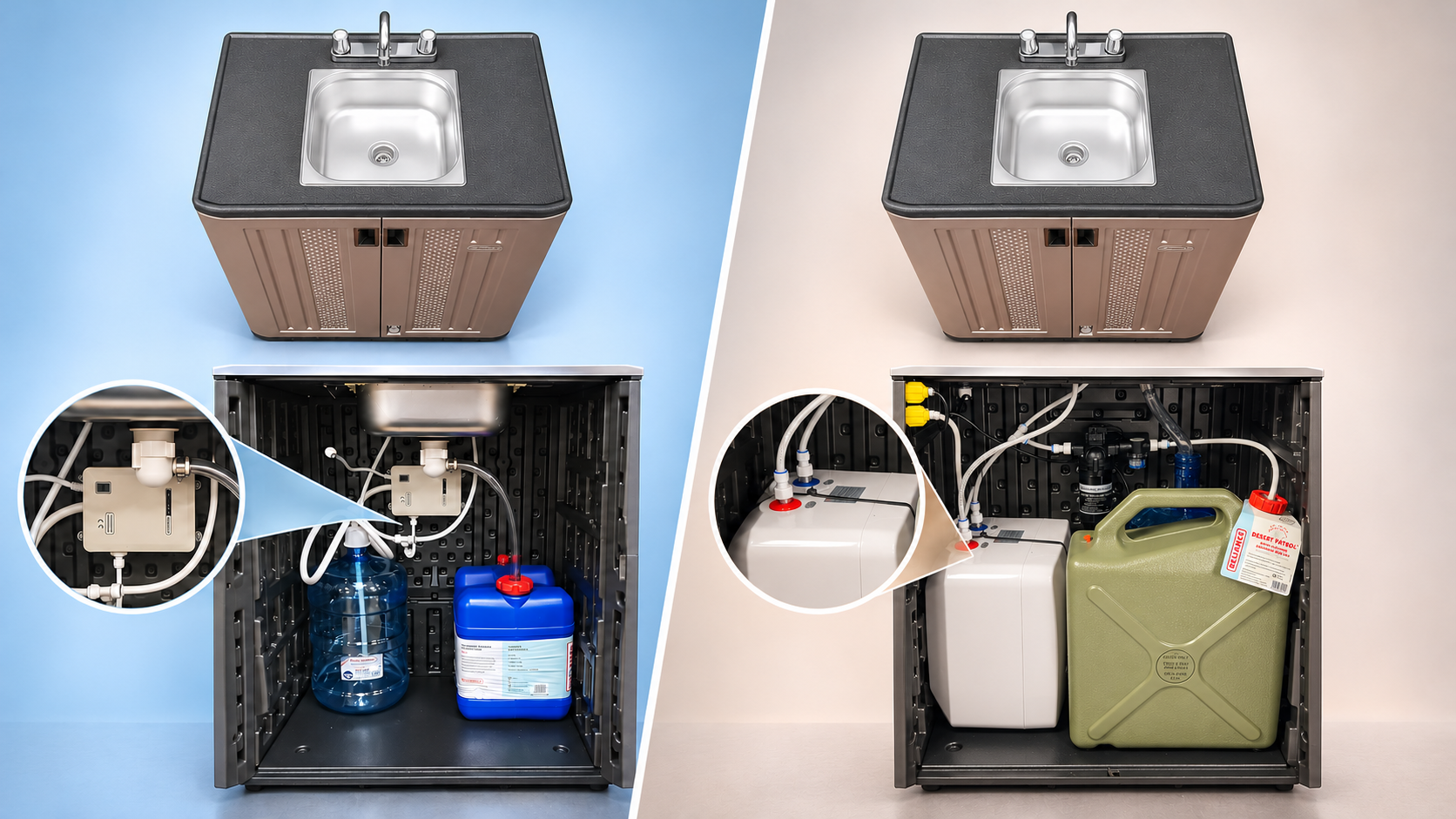
Our Cold Water Portable Hand Wash Station – Model 35-0091 uses a 5-gallon freshwater tank, separate wastewater container, and electric pump to supply pressurized running water. It does not have an onboard water heater.
However, a cold-water station does not actively regulate water temperature. The water delivered through the faucet depends on the temperature of the freshwater supply and its storage conditions.
An unheated model should not be selected when the facility requires consistently heated or tempered water.
What Types of Water Heaters Do Portable Handwashing Stations Use?
Our heated portable handwashing stations use two different electric water-heating configurations: storage heaters and point-of-use heaters.
Understanding how each works helps buyers anticipate performance during repeated handwashing.
2.5-Gallon Electric Storage Heaters
Models 35-0090, 35-0092, 35-0105, and 35-0202 use 2.5-gallon electric storage heaters.
These heaters warm and store a quantity of hot water for use at the faucet. As heated water is used, replacement water enters the heater and must be brought up to temperature.
During periods of frequent handwashing, hot-water demand can temporarily exceed the heater's recovery rate, affecting the temperature available at the faucet.
The 2.5-gallon heater capacity refers to the water stored inside the heater, while the station's 5-gallon freshwater specification refers to its supply tank. Adding a heater does not increase the published freshwater tank capacity. For refill calculations, see our guide: How Many Hand Washes Can You Get From a Portable Sink Water Tank?
Stiebel Eltron Point-of-Use Heaters
Our standard Premier and Pinnacle handwashing stations use the Stiebel Eltron Mini 2-1 point-of-use electric water heater, while our Premier Junior uses a Stiebel Eltron Mini-E thermostatic heater.
Unlike storage heaters, these point-of-use heaters warm water as it flows through the unit rather than maintaining a separate reservoir of preheated water. This eliminates the need to wait for a storage tank to replenish its hot-water supply.
The standard Mini 2-1 provides an approximately 39°F temperature rise above incoming freshwater temperature at a flow rate of 0.32 gallons per minute (GPM).
For example, if the incoming freshwater temperature is 60°F, the resulting water temperature would be approximately 99°F under those conditions.
The Mini 2-1 does not have a published adjustable outlet-temperature range. Actual delivered temperature depends on incoming water temperature and operating conditions, so the heater should not be interpreted as providing unlimited hot water at a fixed temperature.
The Premier Junior's Mini-E heater, by comparison, features thermostatic temperature control with an adjustable temperature-setting range of 86°F–122°F. The Mini-E is factory-set to 100°F, although actual delivered temperature depends on incoming water temperature, flow rate, and heating capacity.
Before choosing a model, verify that its heating performance can meet the water-temperature requirements of your intended application.
How Do Electrical Requirements Compare?
Even without a water heater, our Model 35-0091 requires electricity to operate its pump. Heated models require power for both the pump and water heater.
|
Configuration |
Example Models |
Published Electrical Requirements |
|
Cold water, no heater |
35-0091 |
110V/15A |
|
Hot and cold water, storage heater |
35-0090, 35-0092, 35-0105, 35-0202 |
110V/15A |
|
Hot and cold water, point-of-use heater |
Premier, Pinnacle |
20A power cords; confirm the model's circuit requirements |
For example, Model 35-0092 provides heated water using 110V/15A service, making it an option for locations without the electrical service required by certain point-of-use configurations.
Before purchasing, check the available outlet, circuit capacity, grounding, and required GFCI protection.
What Are the Cost and Maintenance Tradeoffs?
An unheated station generally has fewer components and avoids the additional electricity and maintenance associated with heating water.
For example, our heated Model 35-0092 typically costs about $ 100.00 more than the comparable cold-water Model 35-0091. While prices may change, the approximate difference between these models generally remains similar.
Beyond purchase price, consider:
- Electricity: Cold-water models use electricity for pumping, while heated stations also consume energy to warm water.
- Maintenance: Both configurations require tank cleaning, pump checks, and plumbing inspections. Heated models also need heater-specific servicing, including inspection and mineral-buildup management where applicable.
How Do You Choose Between Hot and Cold Water?
Use these three decisions to narrow down the options before comparing individual models.
- Establish the required water temperature. If the facility must provide a minimum temperature or hot and cold running water, eliminate models that cannot meet that requirement. Confirm that the selected station can deliver the necessary temperature at the faucet.
- Match the station to available electrical service. Check whether the location has an appropriate 110V/15A or 20A circuit. Compare the model's actual electrical specifications rather than assuming all heated units require the same power.
- Evaluate operating demand and heater performance. Consider how frequently the sink will be used, whether a storage or point-of-use heater can support that pattern, and the maintenance responsibilities associated with each configuration.
Compare Hot- and Cold-Water Portable Hand Washing Stations
Compare our hot- and cold-water portable hand washing stations to evaluate heater configurations, basin options, cabinet designs, and electrical specifications before purchasing.