
Get Hitched: Your Ultimate Guide to Motorcycle Trailer Hitches
Posted by The USA Trailer on Jan 30th 2026
Thinking about adding the carrying capacity of a pull behind motorcycle trailer to your bike? The first step is choosing the right hitch. A motorcycle trailer hitch is more than just a piece of metal; it's the critical link that transforms your bike into a versatile touring machine. A quality hitch redefines your motorcycle's utility, providing the extra space needed for extended adventures and the flexibility to carry everything your trip requires.
This guide will walk you through what you need to know about motorcycle trailer hitches. We'll explore the different types available, the benefits they offer, and how to choose, install, and maintain the perfect one for your bike. By the end, you'll have the confidence to get hitched and hit the road.
Types of Motorcycle Trailer Hitches
Motorcycle trailer hitches are defined by their functional design and how they interface with your bike. Choosing the right one depends on whether you prioritize a "hidden" look or a permanent, rugged setup. Accessories and coupling components that affect movement and articulation are addressed separately later in this article.
Receiver-Style (Hidden) Hitches
Receiver-style hitches are a popular choice for riders who prioritize versatility and aesthetics. These are frame-mounted systems that feature a removable receiver tube and ball mount. They are often called "hidden" hitches because once the ball mount is removed, the remaining hardware is tucked away and barely noticeable. This allows the motorcycle to maintain its clean, factory lines when you are not towing.
Fixed-Mount Hitches
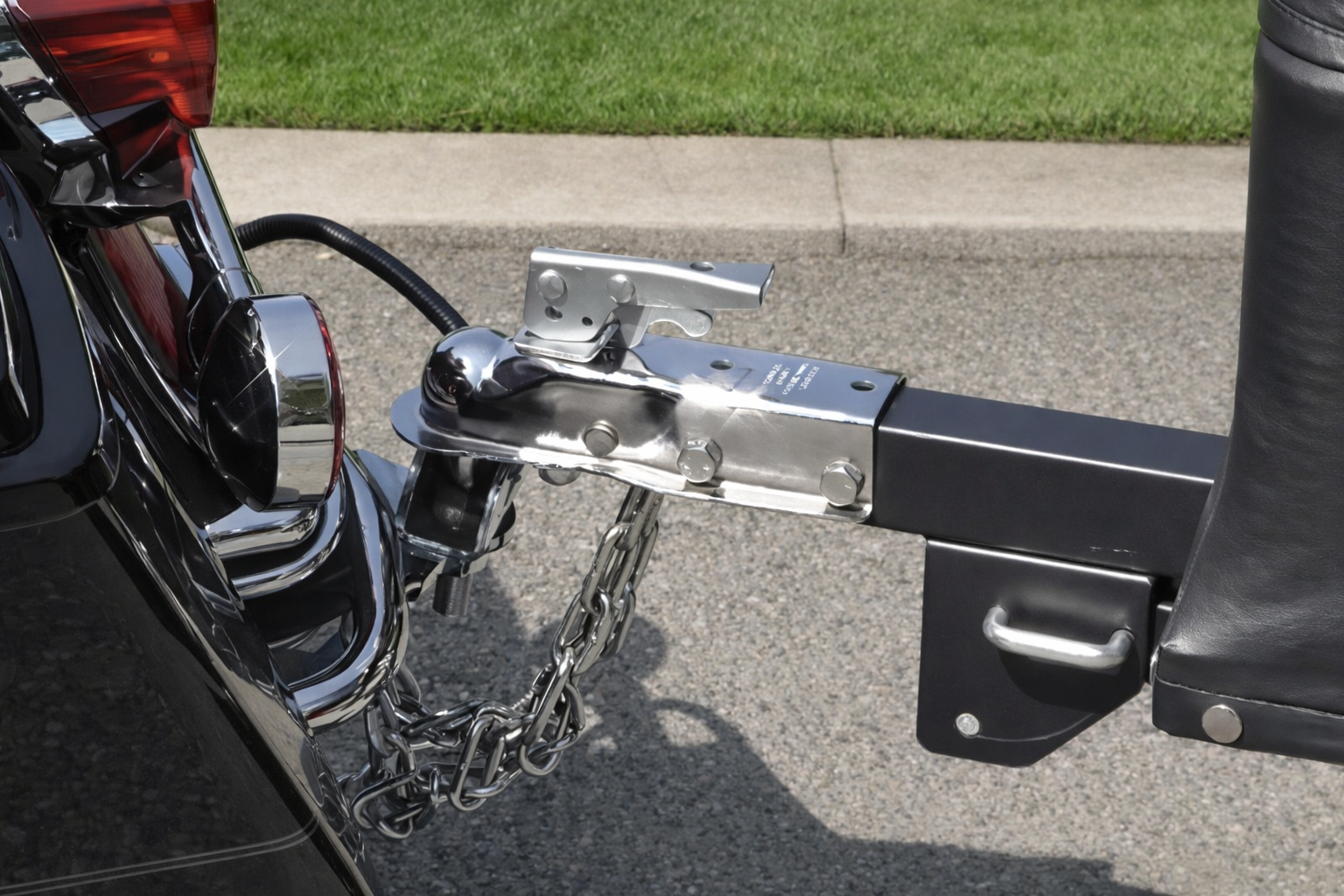
Fixed-mount hitches are designed for maximum durability and simplicity. Unlike receiver styles, these hitches feature a permanent ball mount that remains visible at all times. This non-removable frame-mounted design, featured on models like the Liberty II, is preferred by frequent travelers and long-distance tourers who want a rock-solid, one-piece connection with no moving parts to manage.
Model-Specific Hitches
We offer model-specific motorcycle trailer hitches that are engineered to fit particular makes and models. These hitches are designed, manufactured, and tested in standard configurations to ensure proper alignment, correct load distribution, and consistent towing performance.
Model-specific does not mean custom. Custom hitches are fabricated one at a time to meet an individual customer’s unique request, and we do not offer custom hitch fabrication. Model-specific hitches provide the benefits of a precise, repeatable fit without the uncertainty associated with one-off custom builds.
Hitch Accessories and Coupling Components
While the hitch itself provides the structural connection to the motorcycle, additional components can be added to improve how the trailer moves with the bike. These accessories are especially important for two-wheeled motorcycles that lean while riding.
Swivel couplers and pivot balls are not hitches. They are coupling accessories designed to address the same issue: preventing "binding" between the motorcycle and trailer during a lean. They achieve this in different ways:
- Swivel Couplers: Typically installed on the trailer tongue, swivel couplers allow for a full 360-degree rotation.
- Pivot Balls: These are specialized hitch balls, such as the Freedom Pivot Ball, that allow for articulation at the hitch point itself.
Benefits of Using a Motorcycle Trailer Hitch
Why go through the trouble of adding a hitch and trailer to your motorcycle? The advantages are significant, especially for riders who love to travel.
The most obvious benefit is the massive increase in storage capacity. Saddlebags and tour-packs can only hold so much. A trailer allows you to carry camping gear, extra clothes, tools, and other supplies for extended trips without overloading your bike. This means you can stay out longer and be prepared for anything the road throws at you.
Beyond storage, a trailer hitch enhances your travel flexibility. You can haul equipment for hobbies, bring your pet along in a specially designed carrier, or simply have the convenience of not having to pack light. It transforms a weekend ride into a cross-country adventure.
How to Choose the Right Hitch for Your Bike
Selecting the correct hitch is crucial for safety, performance, and peace of mind. Here are the key factors to consider.
Motorcycle Compatibility
The most important factor is ensuring the hitch is compatible with your motorcycle's make and model. Manufacturers design hitches to fit specific frame geometries and mounting points. Using an incompatible hitch can lead to an insecure fit and unsafe towing conditions. Always check the product specifications to confirm it fits your bike, whether it's a Harley-Davidson Softail, a Honda Gold Wing, or a Can-Am Spyder.
Towing Capacity and Weight Limits
Before you buy a hitch, you need to understand your motorcycle's towing capabilities. Most motorcycle manufacturers do not rate their bikes for towing, so you need to do some simple math. A general rule of thumb is to never pull a trailer that weighs more than half of your motorcycle's weight.
Just as important as total trailer weight is tongue weight, the downward force the trailer’s coupler places on the hitch ball. For safe, stable towing, aim for about 10–15% of the trailer’s fully loaded weight, as too little can cause sway and too much can affect steering and braking. Measure it with a tongue-weight scale or bathroom scale setup and then adjust by moving cargo forward to increase weight or rearward to reduce it.
Material and Construction
The material and build quality of a hitch determine its strength and durability. Most high-quality hitches are made from heavy-duty steel for maximum strength. Look for features like nickel-chrome plating, as seen on the Liberty Hitch II, which not only adds to the aesthetic, but also provides corrosion resistance. A well-built hitch is a long-term investment in your safety.
|
Hitch Type |
Best For |
Key Feature |
|
Receiver Hitch |
Versatility and ease of use |
Concealed design that maintains the motorcycle’s clean lines when not in use. |
|
Fixed-Mount |
Permanent ball mount; simplified, rugged construction. |
Frequent towing and maximum durability. |
A Quick Guide to Installation
Installing a motorcycle trailer hitch is a manageable task for most riders with basic mechanical skills. While instructions vary by model, here is a general overview of the process.
- Gather Your Tools: You will typically need a wrench and socket set, a drill, and a screwdriver. You will also need a wiring harness and trailer connectors to power the trailer’s lights.
- Prepare Your Motorcycle: Keep your bike stable and secure against tipping or unwanted movement.
- Attach the Hitch: Start by removing any components that might interfere with the installation. Position the hitch onto the motorcycle frame, aligning it with the designated mounting points. Secure the hitch with the provided bolts, making sure to tighten them securely.
- Connect the Wiring: The next step is wiring the trailer lights. A plug-and-play wiring harness is the safest and easiest solution. This connects directly to your motorcycle's battery and lighting system without overloading existing fuses or relays. It ensures your trailer's brake lights, taillights, and turn signals work in sync with your bike.
- Test for Stability: Once everything is installed, give the hitch a firm shake to ensure there is no movement. Double-check that all bolts are tight and all electrical connections are secure.
Safety Tips for Towing with Your Motorcycle
Pulling a trailer changes your motorcycle’s handling dynamics. Safety should always be your top priority.
- Practice First: Before heading out on a long trip, practice riding with the trailer in a safe, open area to get used to the new feel.
- Increase Following Distance: The added weight means you will need more room to slow down and stop.
- Mind Your Width: Remember that your trailer is wider than your bike. Be mindful of this when filtering through traffic or navigating tight spaces.
- Take Wider Turns: Trailer wheels track inside the path of your motorcycle. Swing wider through corners to prevent the trailer from clipping curbs or roadside obstacles.
- Check Your Gear: Before every ride, inspect your hitch, coupler, safety chains, and tires. Make sure the trailer lights are working correctly.
- Load Properly: Distribute weight evenly, placing heavier items lower and towards the front of the trailer to maintain a proper tongue weight.
Simple Maintenance for Your Hitch
Proper maintenance ensures your hitch remains safe and functional for years to come.
- Regular Inspections: Routinely check and tighten all bolts and connections on your hitch.
- Lubricate Moving Parts: Apply a high-quality lubricant to moving parts, such as a pivot ball and swivel mechanism, to ensure smooth operation.
- Keep it Clean: Wash off dirt, grime, and road salt to prevent corrosion, especially after riding in bad weather.
Will Installing a Hitch Void My Motorcycle Warranty?
Many riders hesitate to add a hitch because they fear a "voided warranty" lecture from their dealer. It is important to know that you are protected by a federal law known as the Magnuson-Moss Warranty Act. This act prevents manufacturers and dealers from automatically voiding your entire vehicle warranty simply because you installed an aftermarket part or accessory.
Under this law, a dealer must prove that the aftermarket part (in this case, the hitch or the act of towing) directly caused a specific failure before they can deny a warranty claim. For example, if your motorcycle’s infotainment system fails, the dealer cannot refuse to fix it under warranty just because you may have added aftermarket speakers. They must demonstrate a direct link between the accessory and the mechanical issue to deny coverage for that specific repair.
Frequently Asked Questions
Q: Can any motorcycle pull a trailer?
A: Generally, only motorcycles with an engine size of 1000cc or more are recommended for towing. Smaller bikes may not have the power or frame strength to safely handle the additional weight and strain.
Q: What is the maximum weight a motorcycle can tow?
A: The widely accepted rule is that the total weight of the trailer and its cargo should not exceed 50% of the motorcycle's weight. Additionally, the trailer's unladen weight should be clearly marked on the trailer itself.
Q: Do I really need a swivel coupler or a pivot ball?
A: While not mandatory for every setup, adding a swivel coupler or a pivot ball is highly recommended for two-wheeled motorcycles. These accessories improve safety and stability by allowing the motorcycle to lean naturally in corners without being restricted by the trailer. By preventing "binding" between the bike and the trailer, these components ensure a much smoother and safer ride.
Q: How do I make sure my trailer is legal for road use?
A: While specific towing laws can vary by state or region, certain requirements apply to all trailers. Universally, your trailer must be equipped with operable taillights and brake lights, as well as a visible license plate with its own dedicated light. Additionally, safety chains are mandatory for all trailers. These should be crossed in an "X" pattern between the motorcycle and the trailer to provide a secondary connection in the event of a hitch failure.
Conclusion: Get Ready to Hit the Road
A motorcycle trailer hitch is an essential accessory for any rider looking to expand their horizons. It offers the freedom to carry more, travel farther, and experience the open road with fewer limitations. By choosing the right hitch, installing it correctly, and prioritizing safety, you can unlock a new level of versatility for your motorcycle.
Ready to enhance your motorcycle’s utility and take on your next big adventure? Explore our complete range of high-quality, reliable motorcycle trailer hitches today and get ready to hit the road with everything you need.