
What Is a Business Address for Freight Delivery?
Posted by The USA Trailer on Feb 5th 2026
When you order a large item like a trailer, understanding your delivery location is crucial. Freight and LTL (Less-Than-Truckload) carriers have strict rules for classifying a delivery address as either business or residential. This distinction isn't arbitrary; it affects scheduling, the type of truck used, and the total cost of your shipment. Misclassifying your address can lead to unexpected fees, delays, or even a failed delivery. It is important to understand that a home-based business is not considered a business delivery. Simply running a business from your home does not qualify. Carriers use the business-versus-residential classification to plan routes, assign the correct equipment, and ensure safe delivery of your items.
For a freight delivery, a business address is a commercial location open to the public from 9 AM to 5 PM, with staff available to unload shipments and safe access for large trucks. This designation is vital because it signals to the carrier that the destination is a high-traffic commercial zone capable of handling heavy equipment without the need for specialized residential routing.
This guide will explain exactly what freight carriers look for in a business address. We will cover why a home-based business is still considered residential, what equipment you need, and how to choose the right delivery option. Our goal is to help you prepare for a smooth, hassle-free delivery experience from start to finish.
What Is a Business Address for Freight Delivery?
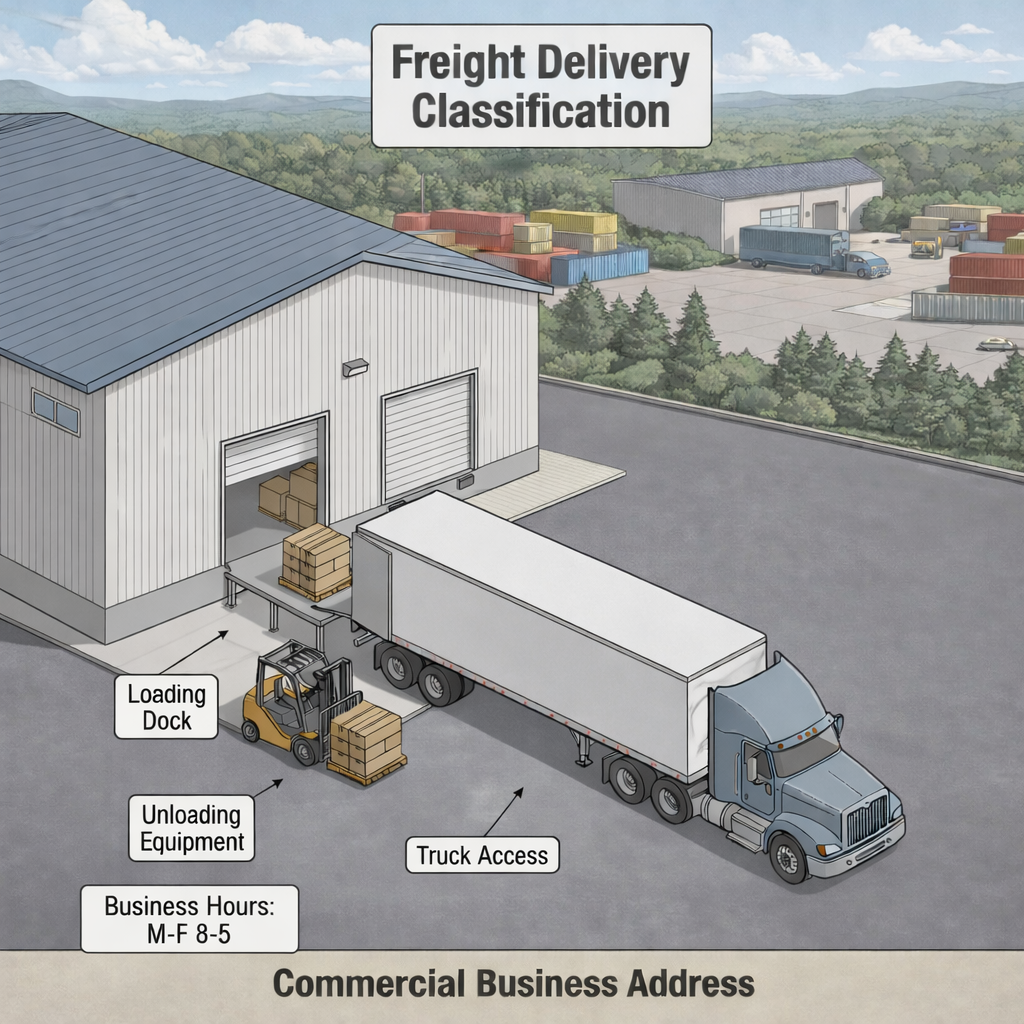
In the world of freight shipping, a "business address" is a specific term with a clear definition. It’s not just any place where business is conducted. Freight and LTL carriers classify a location as a business address if it is a commercially zoned property, typically open to the public during standard business hours. Examples include warehouses, factories, retail stores, and construction sites with a receiving area.
The distinction between a residential vs business delivery is critical for several reasons:
- Scheduling: Carriers create routes assuming business locations are open and staffed from Monday to Friday, usually between 9 AM and 5 PM. Residential deliveries often require appointments, which disrupts this efficient scheduling.
- Equipment: Commercial trucks are large and need ample space to maneuver. Business locations are expected to have loading docks, forklifts, and clear access roads. Residential neighborhoods often have narrow streets, low-hanging wires, and local restrictions that prevent these large trucks from entering. While many commercial sites use loading docks or forklifts to receive freight, a lack of this equipment does not disqualify you as a business address. As long as your location meets the zoning and staffing requirements, a liftgate can be used to bridge the gap between the truck and the ground.
- Safety and Liability: Delivering to a commercial site with proper unloading equipment and trained personnel is safer for the driver and the shipment. Residential deliveries introduce variables that increase the risk of injury or damage.
Because of these factors, carriers apply different rules and pricing for each delivery type. Choosing the correct classification ensures your shipment is assigned to the right truck with the right equipment for a successful delivery.
What Makes a Location a True Business Address?
For a freight carrier to classify your location as a business address, it must meet several specific criteria. These rules are in place to ensure deliveries can be completed efficiently and safely on the first attempt. A true business address must:
- Have Access and Standard Operations: A business address must be staffed and accessible for large semi-trucks between 9 AM and 5 PM on weekdays. This requires a clear path for a 50-foot trailer to enter and maneuver without obstruction from low-hanging lines or tight turns.
- Be staffed during delivery hours. Someone must be present to receive and sign for the shipment. If a driver arrives and no one is there, the delivery will fail, resulting in re-delivery fees.
- Have personnel capable of unloading the freight. While the driver is responsible for getting the shipment to the back of the trailer, your staff is typically responsible for the final offloading. However, for businesses without a dock or forklift, you may request in advance liftgate service. In this case the driver will lower your shipment to the ground.
- Verifiable zoning in carrier databases. Carriers use specialized software like PC*Miler or MapPoint to automatically cross-reference your address against municipal zoning records. If the database flags the location as residential or a "Limited Access" zone, the carrier will apply residential rules regardless of the business activity on-site.
Carriers require these conditions to maintain their operational efficiency. A single delayed delivery can disrupt an entire route, affecting dozens of other customers. By ensuring your location meets these standards, you help the carrier stick to their schedule and avoid costly complications.
Equipment Requirements for Business Deliveries
A key component of a successful business address delivery is having the right equipment on hand. While freight drivers are responsible for transporting your order, they are not required to unload it. The expectation is that a commercial location is prepared to receive heavy freight.
It is strongly recommended that your business location has a loading dock or a forklift available. A loading dock allows for easy transfer of the shipment from the truck trailer to your facility. A forklift provides the flexibility to unload heavy pallets from ground level.
If you do not have a loading dock or forklift, you will need to request liftgate service when you place your order. A liftgate is a hydraulic platform on the back of the truck that lowers the freight from the trailer to the ground. However, liftgate service has limitations. The shipment must fit safely on the platform and not exceed its weight capacity. For oversized items like large trailers, a liftgate may not be a viable option.
It is essential to request liftgate service ahead of time. Trucks with this equipment are dispatched specifically for these deliveries, and a driver cannot add the service on-site. Planning for your equipment needs is a critical step in ensuring a smooth delivery process.
Why Home-Based Businesses Do NOT Qualify
This is one of the most common points of confusion for customers. Even if you run a registered business from your property, carriers will classify a delivery to your house, garage, or farm as residential.
Freight carriers determine the classification based on the physical location and zoning, not the nature of the work done there. If the delivery address is in a residential neighborhood, it is a residential delivery. This policy is not flexible and is enforced industry-wide for several important reasons:
- Accessibility: Residential streets are not designed for semi-trucks. They are often narrow, have tight corners, and may have restrictions on commercial vehicle traffic.
- Lack of Equipment: Homes do not have loading docks or forklifts. This automatically means specialized equipment (a liftgate) or a different delivery plan is needed.
- Scheduling: People are not always home during standard 9-to-5 business hours, so residential deliveries almost always require a scheduled appointment.
Therefore, if you operate a business from home, you must select "residential delivery" during checkout. This ensures the carrier sends the correct type of truckwith a liftgate, and contacts you to schedule a delivery appointment. Alternatively, you can choose terminal pickup, where you collect the shipment yourself from the carrier's local facility.
Timely Unloading Expectations
Freight drivers operate on tightly scheduled routes with multiple stops to make each day. Their time is carefully managed to ensure all customers receive their shipments as planned. For this reason, it is important to be prepared to unload your delivery as soon as the truck arrives.
Customers are expected to complete unloading within 15 minutes. This is a standard industry timeframe. Drivers are not able to wait while you arrange for help or equipment. Delays at one stop can cause a chain reaction, making the driver late for every subsequent delivery.
To avoid issues, plan ahead. Confirm who will be on-site to sign for the delivery. If using a forklift, ensure it is ready to go. Being prepared is a matter of respect for the driver's schedule and helps the entire shipping network run smoothly. If a driver is forced to wait, you may be billed for detention time or charged for a re-delivery if they cannot wait any longer.
Delivery Inspection Requirements for Freight Shipments
At the time of delivery, you must record a clear video of the shipment while the driver is present. The video must show all four sides and the top of the shipment and clearly capture the delivery truck with the carrier’s logo visible.
While recording, carefully inspect the shipment for any signs of damage, zoom in on the damage, and immediately inform the driver if damage is observed. If damage is present, you must clearly state in the video: “My Shipment Is Damaged.”
If the driver provides a paper delivery ticket, you must write “Damaged” on the ticket at the time of signing.
Common Delivery Problems Caused by Misclassification
Choosing the wrong delivery type is more than a simple mistake. It is the leading cause of problems that cost time and money. When you classify a residential address as a business address, one or more of the following issues are likely to occur:
- No One Is Home: The driver arrives during the day, but no one is home to receive the shipment. The delivery fails.
- No Forklift or Dock: The driver arrives expecting you to have unloading equipment, but you don't. They cannot safely get the item off the truck.
- Limited Truck Access: The semi-truck cannot navigate your residential street, get under low-hanging tree branches, or turn around. The driver cannot reach your location.
- Missed Deliveries and Re-Delivery Charges: When a delivery fails for any of the above reasons, the carrier will charge a re-delivery fee. You will also have to reschedule, causing significant delays.
These problems are entirely preventable by selecting the correct delivery option from the start. Please be aware that misclassification often leads to failed deliveries and subsequent redelivery fees, which can cost several hundred dollars and are the responsibility of the customer. In some cases, a missed delivery due to an incorrect address type may require you to pick up your shipment at the local carrier terminal.
How to Choose the Right Delivery Option
Before placing your order, use this simple checklist to determine which delivery type applies to you.
Choose BUSINESS ADDRESS if you can answer "Yes" to ALL of the following:
- Is the address in a commercially zoned area?
- Is the location open and staffed from 9 AM to 5 PM, Monday to Friday?
- Do you have a loading dock or forklift to unload the freight, or can the delivery be completed using a liftgate service?
- Is there clear, safe access for a 53-foot semi-truck to enter and exit?
Choose RESIDENTIAL ADDRESS if you answer "No" to ANY of the above, or if:
- The delivery is to a home, apartment, or farm.
- You run a business from your home.
- The property has limited or restricted access for large freight trucks.
- The location is in a residential neighborhood.
Business vs. Residential Delivery at a Glance
|
Feature |
Business Address |
Residential / Home-Based Address |
|
Carrier Classification |
Commercial |
Residential |
|
Location Type |
Commercially zoned (warehouse, storefront) |
Privately zoned (house, farm, apartment) |
|
Business Hours |
Open & staffed 9 AM–5 PM on weekdays |
No set hours; appointment required |
|
Staffing |
Personnel available to sign for and unload |
Resident must be present at appointment time |
|
Required Equipment |
Loading dock or forklift recommended |
Liftgate service required (if available) |
|
Delivery Expectations |
Unload within 15 minutes of truck's arrival |
Driver will lower freight with liftgate |
Frequently Asked Questions
Q: What if I have a business, but it's on a farm?
A: A farm is considered a residential or limited access location by freight carriers due to potential access issues for large trucks. You should select residential delivery or terminal pickup to ensure the carrier can service your address and avoid any delivery failures or extra fees.
Q: Can I use liftgate service at a business address?
A: Yes, you can request liftgate service for a business address delivery if you do not have a loading dock or forklift. This must be requested when you place your order, as not all trucks are equipped with a liftgate. Additional fees for this service will apply.
Q: What happens if I choose business delivery for my home address?
A: This will likely result in a missed delivery and redelivery fees of several hundred dollars. It will also delay your shipment, as the carrier will need to contact you to schedule the redelivery.
Q: What are the benefits of choosing terminal pickup?
A: Terminal pickup is a reliable option for those who prefer to manage the final transport of their freight. It eliminates the need to coordinate a delivery or worry about truck access.. Once the shipment arrives at the local hub, the carrier will notify you. You will then have a limited window, typically 24 to 48 hours, to collect your items with a suitable vehicle.
Plan Ahead for a Successful Delivery
Understanding the difference between a business and residential address is the key to a smooth and predictable freight delivery with The USA Trailer Store. Carriers define a business address as a commercial location with regular hours, on-site staff, and the equipment needed to unload heavy items. A business operated from a home does not meet these criteria and is always classified as residential. By accurately identifying your delivery location, you can prevent extra fees, delays, and the frustration of a failed delivery attempt.
Being prepared is everything. Review your location’s accessibility, confirm you have the right equipment, and be ready to unload when the truck arrives. If you have any doubt about which delivery option is right for you, please contact The USA Trailer Store team. We are here to help you choose the best solution for a successful and stress-free delivery.