The Facts About NSF Certification: A Guide for Hot Dog Vendors
Posted by The USA Trailer on Jan 9th 2026
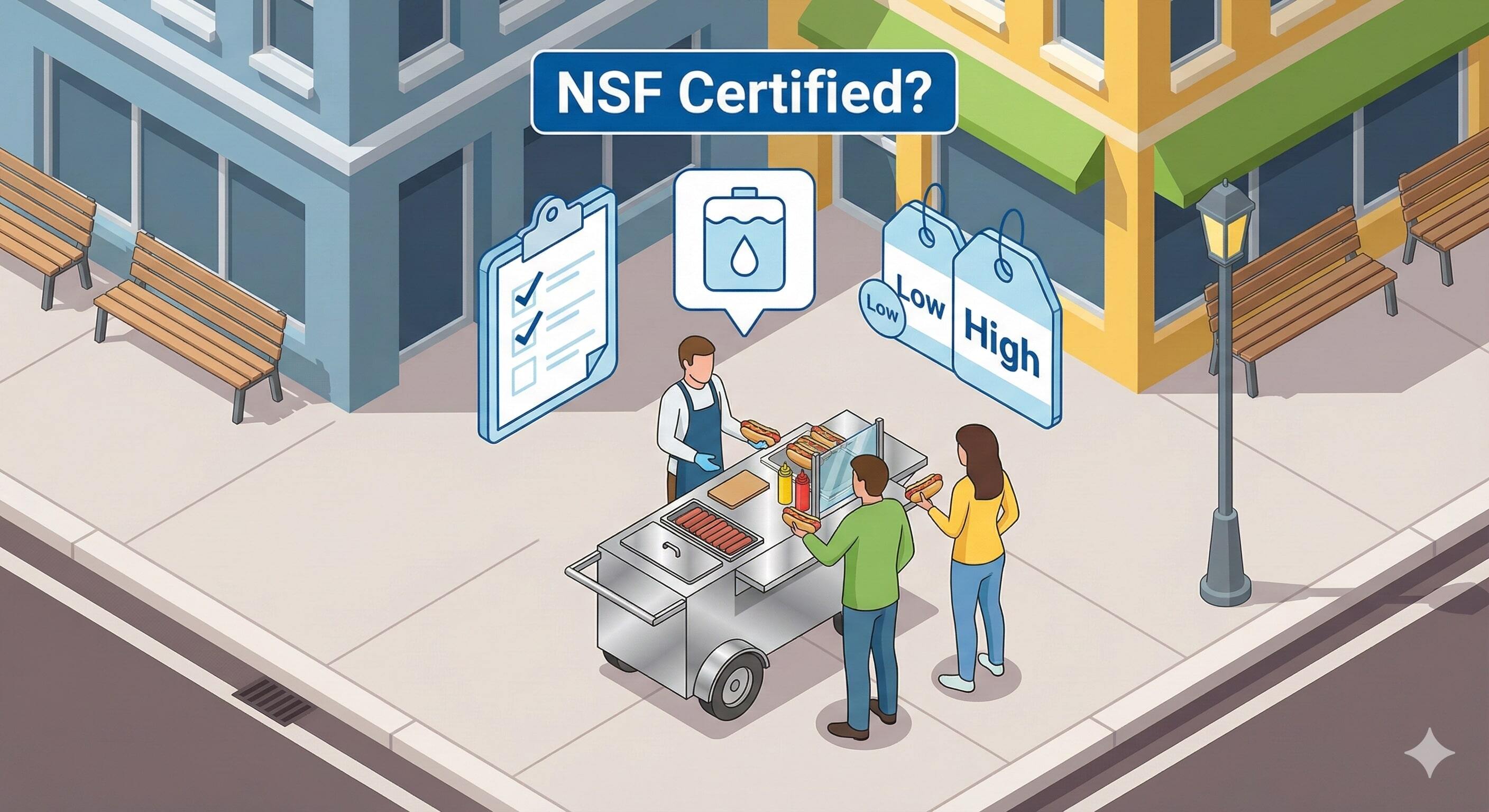
If you have been exploring the various hot dog carts available on the market today, you have likely encountered the term NSF certified quite frequently. A few specific cart manufacturers offer these NSF certified carts or specialized components, but they often come at a substantial additional cost to the buyer. Because this is such a significant investment for a new business owner, it is important to review the facts about what NSF certification actually is and what it is not.
Who is the NSF?
The organization known as the NSF was originally formed in 1944. At that time, it was created to meet a growing need to standardize the requirements for equipment and various processes across a number of different industries. This was particularly important in the food service sector where sanitation is a primary concern. The original name of the organization was the National Sanitation Foundation, but this title was eventually shortened to simply NSF in the 1980s.
It is important to understand that the NSF is not directly affiliated with any United States government agency or any federal department. Basically, the company acts as a third party that certifies that specific products meet the standards established by the American National Standards Institute, which is also known as ANSI.
The role that the NSF plays is very similar to the role that the well-known Underwriters Laboratories, or UL, plays in a number of other technical industries. In addition to their work in the food service industry, the NSF also certifies the standards for products and processes in a wide variety of other sectors. These other industries include the automotive field, the aerospace industry, and the production of medical devices.
Why Most Manufacturers Avoid Full Certification
Despite the prevalence of the name, most hot dog cart manufacturers do not actually have their finished products certified by the NSF. There are several practical reasons for this. Primarily, the process to obtain NSF certification is a very lengthy, labor intensive, and extremely costly endeavor. The certification process may include rigorous testing of every single material used to manufacture a product. It also involves an intense review of the specific facilities and the manufacturing processes involved in the creation of the carts.
For that specific reason, any products that are NSF certified, including hot dog carts, can be much more expensive for the consumer to purchase. However, it is a common misconception that a higher price tag indicates a superior build. The higher price does not mean the product itself is any better or any safer than a non-certified version of the same equipment.
For example, the hot dog carts sold by The USA Trailer Store are high quality, reliable, and long-lasting products. They offer these benefits at a reasonable price without the added overhead of the full certification process. You are getting a durable piece of equipment that is built to last without paying the premium associated with the NSF logo.
Determining if You Need a Certified Cart
The answer to whether or not you need a certified cart depends entirely on the specific requirements in your local area. It is vital to remember that health and safety requirements are controlled by state and local governments rather than a national standard. Because of this localized control, the rules can vary a great deal from one county to the next.
If you are considering purchasing a hot dog cart for use in a specific city or county, it is imperative that you understand and adhere to the codes that govern that specific location. While they may not require the entire cart to be certified, they may require that specific individual components must meet NSF standards. These components often include:
- The stainless steel pans used for food service.
- The water tanks used for handwashing and cleaning.
- The water pump that moves liquid through the cart system.
The county health department is likely to have many resources available to help you meet their specific local requirements. You can usually find printed copies of the local codes on their official website or by making a request in their physical offices. Some health departments even go as far as to offer online courses or live classroom sessions that teach you how to properly create a food service business. You should explore all these options and fully understand the requirements of your jurisdiction before you commit to purchasing a hot dog cart.
The Difference Between NSF Certification and Meeting NSF Standards
People often hear “NSF” and think it’s one single thing. It’s actually two different concepts, and that’s where confusion starts. Think of it like this: NSF Standards are the rules and NSF Certification is a paid approval sticker.
NSF publishes detailed rules that explain how food equipment should be built to be safe and sanitary. These rules cover things like what materials can be used, for example, stainless steel, how sinks and water tanks are sized, and how surfaces are cleaned and drained. If a cart is built following these rules, it is considered NSF-compliant by design, even if it does not have an NSF logo on it.
NSF certification is an extra step. In this case, the manufacturer pays NSF, NSF tests the equipment, and NSF inspects the factory. If everything passes, NSF allows the product to display the official NSF logo. That logo tells health inspectors: “This product has already been reviewed and approved by NSF.”
An easy example of this is water tanks. NSF standards say that on a food cart, the wastewater tank must be at least 15% larger than the fresh water tank. If a cart is built this way, it meets the NSF standard by design. It doesn’t need a sticker to prove the tanks are the correct size: the design itself already follows the rule.
Most local health departments focus on how the cart is built, not whether it has an expensive logo. If a cart uses proper stainless steel, has correctly sized tanks, and is designed to be clean and sanitary, it will often be approved during inspection, even without NSF certification.
Why this matters for new vendors is that NSF certification adds cost. Those costs get passed on to the buyer. By choosing a cart that meets NSF standards but does not carry the NSF logo, you can save money upfront and still pass local health inspections while keeping startup costs lower.
The Bottom Line for Your Business
The key to getting the right cart for your needs is to find a unit that meets your specific business requirements while complying with the necessary health department rules. You want a cart that is available at a reasonable price so you can keep your overhead low. By thoroughly researching your local codes and regulations, you can make an informed purchase that protects your investment.
Paying a premium price for an NSF compliant hot dog cart is essentially a waste of money if it is not necessary to meet your local requirements. A high priced cart means it will take much longer for your new business to become profitable. Since profitability is the ultimate goal of starting a business, making a smart choice on your equipment is the best way to ensure your success.
Helpful Resources for New Vendors
- Health Guide USA has links to local health departments here.
- You can visit the NSF website.
- Toast has a good primer on starting a hot dog vending business.