
LTL Delivery and Liftgate Service: A Complete Guide
Posted by The USA Trailer on Feb 6th 2026
Ordering a new trailer is exciting, but the delivery process can introduce unexpected challenges. Most trailers ship via LTL (Less Than Truckload) freight, which means your shipment shares space on a large semi-truck with other freight. This keeps costs lower but adds mechanical limits during unloading.
Liftgates are a standard requirement for all residential deliveries to ensure the heavy freight reaches the ground safely. They are also essential for small businesses that operate without the benefit of a dedicated loading dock or a forklift on-site. By using this hydraulic service, carriers can bridge the gap between the high truck bed and your delivery point.
Because LTL trucks sit several feet off the ground and do not carry forklifts, deliveries often rely on liftgate service. A liftgate makes curbside unloading possible, but it is not a universal solution. It has strict size, weight, and balance limits. If those limits are exceeded, delivery may become unsafe or physically impossible. Understanding how freight actually moves from inside the truck to the ground helps prevent delays, damage, and failed deliveries.
Understanding Delivery Location Access
Before unloading can begin, the truck must be able to safely reach the location and park. Freight trucks are typically 48 to 53 feet long and require:
- Wide paved roads
- Room to maneuver
- Flat, solid pavement
- Clearance behind the truck to lower the liftgate
Narrow streets, steep grades, soft surfaces, or overhead obstacles can prevent safe unloading. Even if the liftgate functions properly, delivery cannot proceed if the truck does not have a safe place to operate.
What Is a Liftgate and How Does It Work?
A liftgate is a hydraulic platform mounted to the rear of a freight truck. It works like a small elevator, lowering heavy shipments from trailer height to ground level.
Typical liftgate specifications
- Width: 80 to 84 inches
- Depth: 55 to 60 inches
- Capacity: Approximately 2,500 pounds
Your shipment must fit completely within these dimensions and remain centered. Any overhang or imbalance increases the risk of tipping.
The Role of the Pallet Jack
Inside the trailer, the driver’s only tool is a manual pallet jack. This is a hand-powered device with two forks that slide under the pallet. The driver pumps the handle to lift the load slightly and then pushes or pulls it into position.
Important limitations:
- No motor
- No brakes
- Fully manual control
- Works on flat surfaces
Because it is manually operated, heavy loads can quickly become difficult to control, especially on slopes.
How Freight Moves From Truck to Liftgate
The unloading process follows a specific sequence. First, the driver rolls the pallet from inside the trailer toward the rear door using the pallet jack. Before reaching the liftgate, the pallet usually must be rotated to line up with the opening.
This turning step is required. The inside width of a freight trailer is generally 96 to 102 inches. If the pallet is too long, there is not enough space to rotate the pallet. When this happens, the shipment cannot reach the liftgate at all. Even if the weight is acceptable, delivery fails because the crate physically cannot turn and be positioned onto the liftgate
When a Pallet Is Too Large
Liftgate size creates another limitation. Consider this example:
- Liftgate depth: 60 inches
- Pallet length: 96 inches
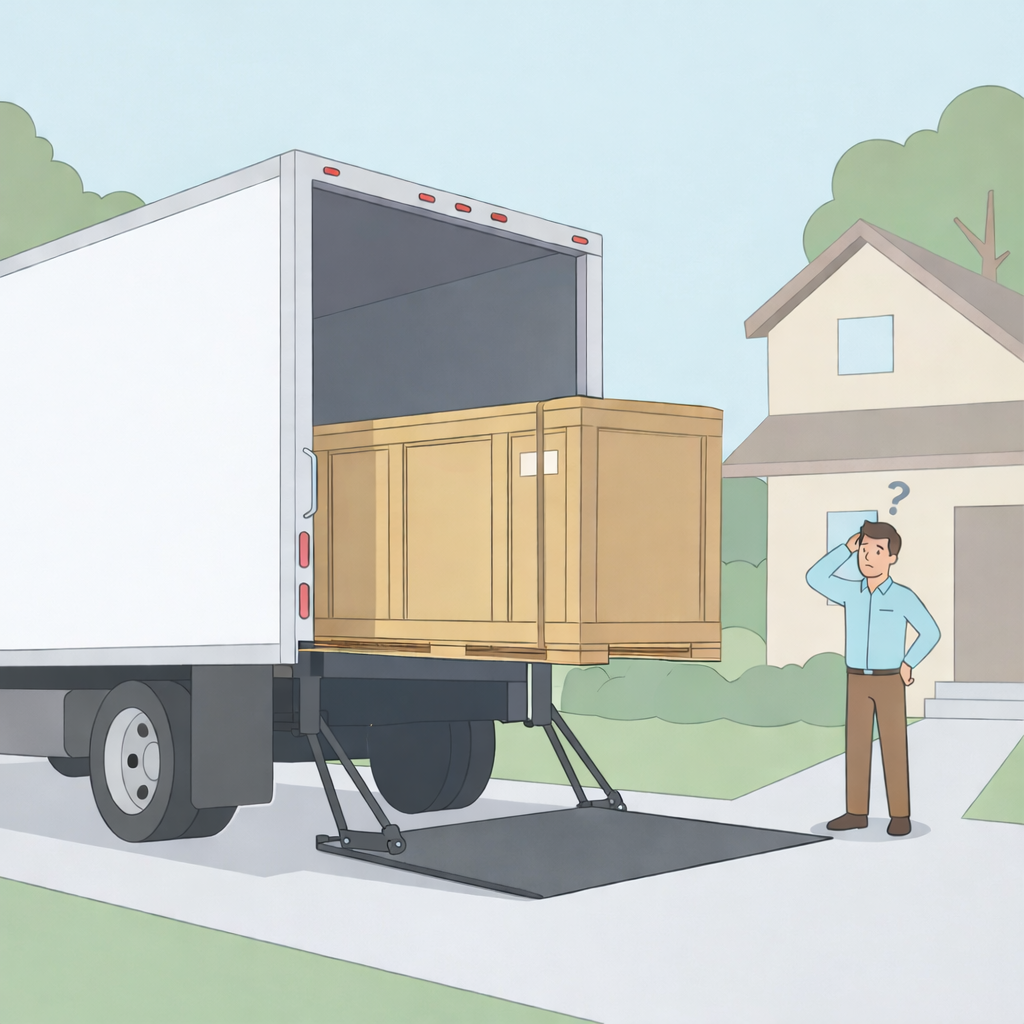
Nearly three feet would hang off the edge. This creates a serious tipping hazard. As the platform lowers, the center of gravity shifts outward, increasing the chance the pallet will slide or fall. Overhanging freight can also strain the liftgate’s hydraulic arms and cause equipment damage.
For safety reasons, drivers will refuse to unload pallets that cannot sit fully and securely on the platform. If the pallet is too long to turn inside the truck or too large to fit on the liftgate, unloading is not possible.
Summary of Liftgate and Maneuvering Limits
|
Factor |
Within Limits |
Delivery Problem |
|
Pallet length |
Under 60 to 72 in |
Over 84 to 96 in |
|
Turning space |
Rotates inside trailer |
Too long to turn |
|
Weight |
Under 2,500 lbs |
Exceeds rating |
|
Balance |
Centered on platform |
Overhang or off-center |
Dangers of Exceeding Equipment Limits
Ignoring these limits creates real safety risks:
- Loss of control: Manual pallet jacks have no brakes. A heavy load can roll faster than a person can stop.
- Tipping hazards: Overhanging pallets may fall from the liftgate as it lowers.
- Equipment failure: Overloading can damage hydraulic arms or cause sudden drops.
- Property damage and liability: Falling freight often results in serious damage and complicated insurance claims.
For these reasons, drivers prioritize safety and may refuse unsafe deliveries.
How a Safe Liftgate Delivery Happens
A typical successful delivery looks like this:
- Truck parks on flat pavement with enough space to operate
- Driver moves the pallet using a manual pallet jack
- Pallet rotates inside the trailer if needed
- Pallet is centered fully on the liftgate
- Platform lowers to ground level
- Shipment is placed curbside
The driver’s responsibility ends at the curbside.
Frequently Asked Questions
Q: What does curbside delivery mean?
A: The shipment is lowered to the ground at the curb or driveway only. Drivers do not move freight into buildings or garages.
Q: Can the driver help reposition the pallet to my garage?
A: No. Manual pallet jacks cannot safely cross gravel, grass, or slopes, and insurance policies restrict drivers from entering private property.
Q: How do I know if my shipment is too large for liftgate delivery?
A: If the pallet exceeds about 84 to 96 inches in length or weighs more than 2,500 pounds, it may exceed liftgate limits.
Q: When is terminal pickup a better option?
A: Terminal pickup is required for long or heavy shipments. If you choose this option, you must ensure you have a truck or a trailer large enough to safely handle the dimensions and weight of the shipment when you arrive to retrieve it.
Conclusion: Prepare, Measure, and Plan
Liftgate delivery works best when shipments fit comfortably within the limits of both the pallet jack and the liftgate platform. If your pallet is unusually long, heavy, or difficult to maneuver, terminal pickup is often the safer and more reliable choice.
Confirm your shipment’s dimensions and ensure your location provides safe access before scheduling delivery. Understanding limitations helps prevent delays and ensures smooth receipt of your order.